The importance of digital marketing in the AI era
How customers now find businesses through Google's AI answers, Maps, ChatGPT and WhatsApp, why the basics count for more, and a checklist to get your business ready.
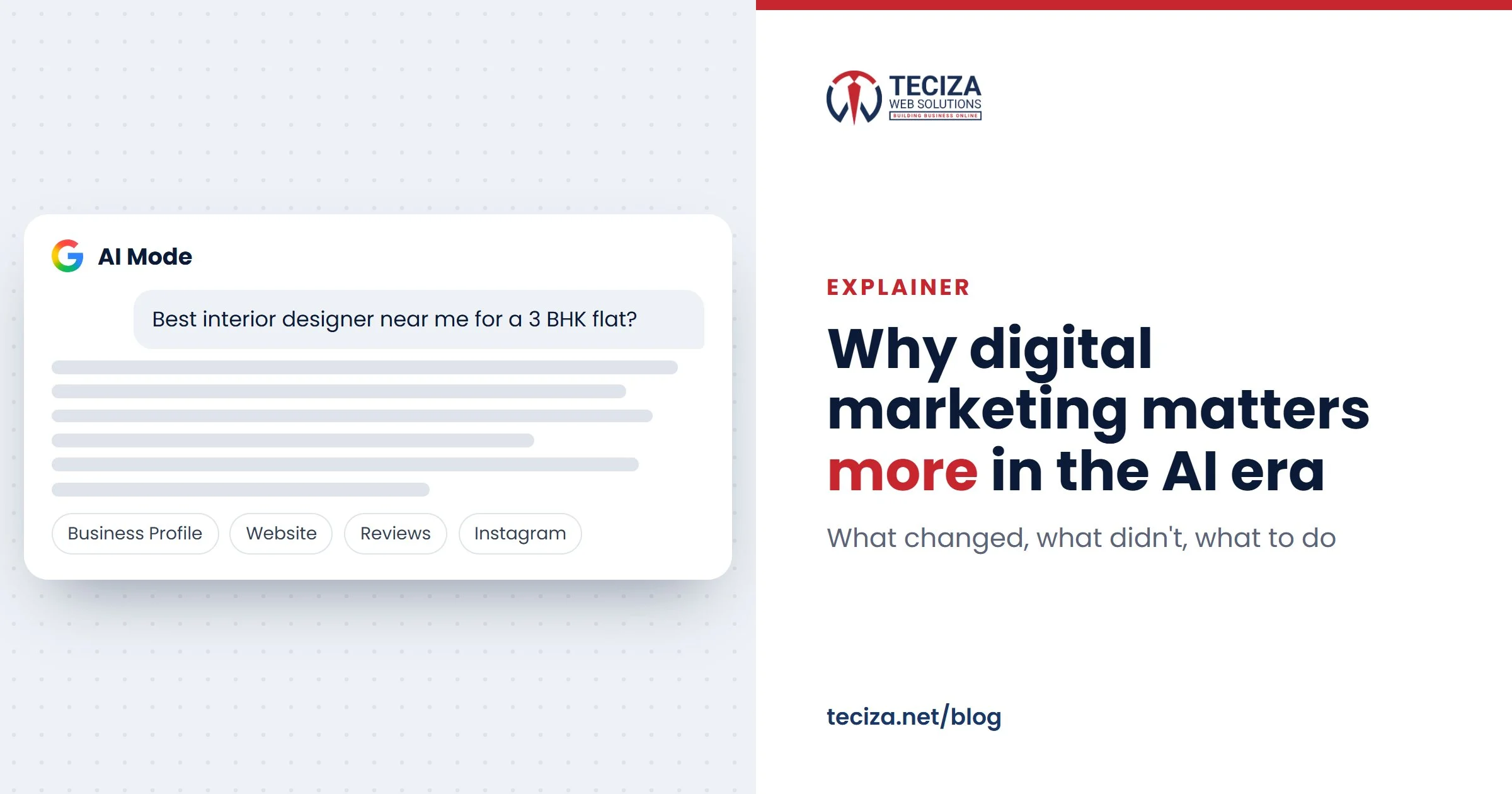
Short answer: the importance of digital marketing has grown in the AI era, not shrunk. Google’s AI Overviews and AI Mode, ChatGPT and other assistants build their answers from what they can find about a business online: its website, Google Business Profile, reviews and the facts other sites repeat. If that information is missing or inconsistent, AI tools have little to say about you, and customers pick a business they can check.
This guide is for business owners in India who want to know what AI really changes for getting enquiries: how customers find businesses now, what AI SEO and generative engine optimization mean according to Google, Bing and OpenAI, what changes in daily marketing work and what doesn’t, and a checklist to start this month.
How customers find and choose a business now
Take a family in Ahmedabad looking for a dentist for their six-year-old. They might ask Google’s AI Mode for “a child-friendly dentist in Bopal open on Sunday”, read an AI answer naming a few clinics, compare reviews and photos on the map, check two clinics’ websites and Instagram pages, then send a WhatsApp message to, or call, the most reliable one. Some ask ChatGPT first.
The pattern is ask, compare, check, contact, and most of the decision is made before the business hears from the customer.

Official numbers show why this matters in India:
- India had 1,114.17 million internet subscriptions at the end of June 2026, 1,066.43 million of them wireless (TRAI; connections, not unique people). The average mobile data user used 28.39 GB a month.
- Google says queries in AI Mode are on average three times longer than traditional searches, and one in five AI Mode searches worldwide use voice, images or documents (October 2026).
- Since March 2026, Search Live (talking to AI Mode, with the phone camera if needed) works in Gujarati, Marathi, Tamil, Bengali and other Indian languages, besides English and Hindi.
Longer questions favour businesses that explain themselves clearly. “Dentist for a nervous child near Bopal with Sunday appointments” matches the clinic whose website and profile actually say those things.
Why AI makes the basics of digital marketing more important
AI answers are not written from nothing. Google says its AI features are rooted in its core Search ranking and quality systems: they draw on the search index and use “query fan-out”, running several related searches to collect sources. To appear as a link, a page must be indexed and eligible to show in Google Search with a snippet, just as for normal results.
People are not searching less, either. Google says that in its biggest markets, the US and India, AI Overviews led to over 10% more use of Google for the types of queries that show them (Google’s data, September 2024 to April 2025).
ChatGPT works on a similar principle: OpenAI says its OAI-SearchBot crawler surfaces websites in ChatGPT search, and sites that block it are not shown in its search answers. Bing Webmaster Tools now shows how often your pages are cited in Copilot and Bing’s AI summaries. All these tools read the same raw material, so a weak online presence costs more: the answer about you is written before the customer reaches you.
| Where people ask | What the answer draws on | What you control |
|---|---|---|
| Google Search, AI Overviews, AI Mode | Pages in Google’s index, Business Profiles, Merchant Center product data | Your web pages, crawl access, your Business Profile |
| Google Maps | Business Profile, reviews, distance | A complete profile, real reviews, your replies |
| ChatGPT search | Web pages ChatGPT can find and read | Allowing OAI-SearchBot, pages that answer questions |
| Microsoft Copilot and Bing | Bing’s index, Bing Places listings | Bing Webmaster Tools, Bing Places, current pages |
| Instagram and WhatsApp | Your posts, photos and replies | Real photos, quick and helpful replies |
What AI SEO and generative engine optimization really mean
“Generative engine optimization” (GEO), “answer engine optimization” (AEO) and “AI SEO” are new names for getting into AI-written answers, often sold as a separate service. Google’s own guide, Optimizing your website for generative AI features on Google Search, is direct: optimising for generative AI search is optimising for the search experience, “and thus still SEO”. Google says you can skip:
- New machine-readable files, AI text files such as llms.txt, or special markup.
- Cutting pages into small chunks or rewriting them in an “AI style”.
- Special schema: structured data isn’t required for AI features, though it still helps with rich results.
- Artificial mentions of your brand around the web.
It also warns that a page for every variation of a question, made mainly to influence rankings or AI answers, can break its spam policy on scaled content abuse. What Google asks for is what good SEO always needed: crawlable, indexable pages, a good phone experience and helpful, first-hand content.
And ChatGPT, Copilot and other assistants?
OpenAI recommends allowing OAI-SearchBot in your robots.txt file to appear in ChatGPT search, and says changes take about 24 hours. You can allow it while blocking GPTBot, the crawler OpenAI uses to collect training content. Bing’s advice from February 2026: keep content fresh and accurate, use clear headings, tables and FAQ sections, report changed pages with IndexNow, and keep Bing Places for Business current.
One check from our own work: make sure robots.txt, the firewall and your host’s bot protection don’t block Googlebot, Bingbot or OAI-SearchBot. We have seen a host’s server-level bot protection answer AI crawlers with error codes, a setting the site owner could not change in the hosting panel.
Be careful with promises. Nobody can guarantee that ChatGPT or Google’s AI will recommend your business, and Google says no third-party tool has access to its internal ranking or AI systems. Ask anyone selling “guaranteed AI rankings” exactly what work they will do.
To check progress: Google Search Console reports how often your pages appear in AI Overviews and AI Mode (for all websites since the end of August 2026), and Bing Webmaster Tools reports citations in Copilot. Our SEO service treats Google, Bing and AI answers as one job, because in practice it is.
Local businesses: your Business Profile is now part of the answer
For a business that serves a city or an area, Google says Business Profiles can help your products and services show up both in AI responses and in other Search results. Ask AI Mode for “a CA firm in Vadodara that handles GST for small traders”, and each firm’s categories, services, hours, photos and reviews are part of what Google works from.
Local ranking still rests mainly on relevance, distance and how well known a business is. More reviews, positive ratings and complete, accurate information help, and you can’t pay for a better local ranking.
No profile yet? Start with our guide on how to create and verify a Google Business Profile, or see our Google Business Profile service. Ranking locally also involves your website, listings and local links: see what local SEO is.
What AI changes in day-to-day digital marketing
Ads: the platforms do more of the targeting
Google’s AI Max for Search campaigns can match searches beyond your keyword list, write ad text from your existing ads and landing pages with generative AI, and send people to the best-fitting page on your site. Meta’s Advantage+ setup manages budget, audience and placements across Meta’s apps.
Ads have also moved into AI answers. Google lists India among the countries where ads can appear within AI Overviews and AI Mode (in English), labelled “Sponsored”. Existing Search, Shopping and Performance Max campaigns qualify automatically, with no separate opt-out, and Google says paid ads don’t influence the AI’s own answers. For ads inside AI assistants, see our article on ChatGPT ads.
Automation works towards whatever you count as a result: count junk form fills as conversions and it will tend to find you more of them. Our advice: track real enquiries (calls, WhatsApp clicks and forms), judge campaigns on enquiries and sales rather than clicks, and keep the ad account in your business’s name. When we run campaigns, the client pays the ad budget directly to Google or Meta and our fee is separate. Deciding where to spend? Compare Google Ads and Meta ads, or SEO and Google Ads.
Content: drafts are faster, experience is scarcer
AI tools write a first draft in seconds, and Google allows AI-assisted content that meets its spam policies. But everyone has the same tools, so generic text is everywhere. What AI can’t write is your experience: the questions customers actually ask, the mistakes you see, how your pricing works. Google says it prefers exactly that.
We saw this on our own site. In our Search Console data for 2026, almost every search that brought visitors to teciza.net was our name or “company in Ahmedabad”. There were no question searches at all, because we had answered none. That is why this blog exists.
Customer replies: instant answers, with a person behind them
An AI chatbot on your website or WhatsApp can answer routine questions at any hour: timings, location, delivery areas, order status. Our advice: hand over to a person for custom prices, complaints and anything that needs judgement. To set one up, see our AI and automation services.
What AI does not change: trust, real offers and follow-up
AI summarises reports faster, but it can’t decide what success means for your business; for most, that is still enquiries and sales. Three other things stay with you:
- Trust is still earned. People choose businesses with real reviews, real photos, a named team and a clear address. AI gives customers more ways to find and compare you; it can’t create these signals.
- The offer is still yours. A clear service, an honest explanation of how pricing works, delivery times and what happens if something goes wrong.
- Follow-up still decides the sale. Enquiries are often lost after they arrive: a missed call, a WhatsApp message answered the next day, a quote never sent.

Read this comparison as a table
| Area | What AI changes | What still needs you |
|---|---|---|
| Search | Longer questions, AI-written answers | Pages that answer them well |
| Ads | Automated targeting, ad text and placements | Your offer, budget and real tracking |
| Content | Fast first drafts | Your experience, facts and opinions |
| Customer chat | Instant replies at any hour | A person for prices and complaints |
| Trust | More ways to find and compare you | Real reviews, photos and service |
| Reports | Faster summaries | Enquiries and sales as the measure |
Your AI-ready checklist: where to start
This is the order we would work in. The first four steps cost little more than time.

- Make your facts match everywhere. Name, address or service area, phone, WhatsApp, hours and services: identical on your website, Business Profile, social profiles and directories.
- Complete your Business Profile on Google, and Bing Places too: categories, services, description, hours, photos.
- Give each main service its own page saying what you do, for whom, where, and how to contact you, in your customers’ words.
- Let search engines in. Allow Googlebot, Bingbot and OAI-SearchBot, and set up Google Search Console and Bing Webmaster Tools.
- Collect real reviews. Ask every customer when the job is done, and reply to each review.
- Answer real questions. Turn your most common phone and WhatsApp questions into FAQs and guides with your own examples.
- Track enquiries, not just visits. Count calls, WhatsApp clicks and forms in Google Analytics.
- Run measured ads. Start with a budget you can afford to test and judge it on enquiries and sales.
Why this order: steps 1 to 4 are what people and AI tools read first, and ads that send people to a weak website or an empty profile often pay for clicks that never become enquiries.
Common questions
Is digital marketing still important now that AI answers questions?
Yes, more than before. AI answers are built from what businesses publish and what others say about them, so a clear website, a complete profile and real reviews give AI tools something accurate to say.
How is AI used in digital marketing?
Mainly in ads (automated targeting, ad text and budgets), content (ideas and first drafts), customer replies (chatbots) and reports. A person still sets the goal, the offer and the facts.
What is generative engine optimization?
The work of getting your business mentioned or linked in AI-written answers. For Google it is the same as good SEO: Google says optimising for generative AI search is “still SEO”.
How do I rank in ChatGPT?
Nobody controls it, but you can be easy to find: allow OAI-SearchBot in robots.txt, publish clear pages that answer real questions, keep your facts consistent and earn genuine reviews. Be wary of anyone who guarantees it.
Do I need an llms.txt file for AI search?
Not for Google. Google says you don’t need AI text files or special markup to appear in its AI features.
AI has not replaced digital marketing. It has made the basics more visible: whatever is true, clear and consistent about your business online is what customers and AI tools will find. Start with the first three checklist items this month. If you’d like help, we work with businesses in Ahmedabad, across India and abroad.
Sources: Google Search Central: Optimizing your website for generative AI features on Google Search; Google: Q3 2026 earnings call: Remarks from our CEO; Google Business Profile Help: Tips to improve your local ranking on Google; Google Ads Help: About ads in AI-powered experiences in Google Search; Meta for Developers: Advantage+ campaign experience for sales and app; OpenAI: Overview of OpenAI crawlers. Checked November 2026.
Written by the Teciza Team: digital marketing, software and website specialists in Ahmedabad since 2015. Last updated 14 Nov 2026.
More guides
Best SEO company in Ahmedabad: how to choose one you can trust
The checks to make, questions to ask and red flags to avoid before you hire an SEO company, plus what honest work and a useful report…

Digital marketing for doctors in India: what works and what’s allowed
What the NMC's October 2026 guidelines let doctors and hospitals share online, what to avoid, and the compliant steps that help patients find and book you.
Want help with this?
- Tell us what you needMarketing, software or a website.
- We look at your businessYour site, your market, your goals.
- We call you backWith ideas and, if you want, a quote.
Tell us about your business
A few short questions. We reply by call or WhatsApp, 7 days a week.
Your details are only used to reply to you. Need a detailed quote? Fill our project brief.