What is performance marketing? Meaning, channels and how to measure it
What performance marketing means, how it differs from brand and digital marketing, the channels and pricing models, and how to measure it with CPL, CPA and ROAS.
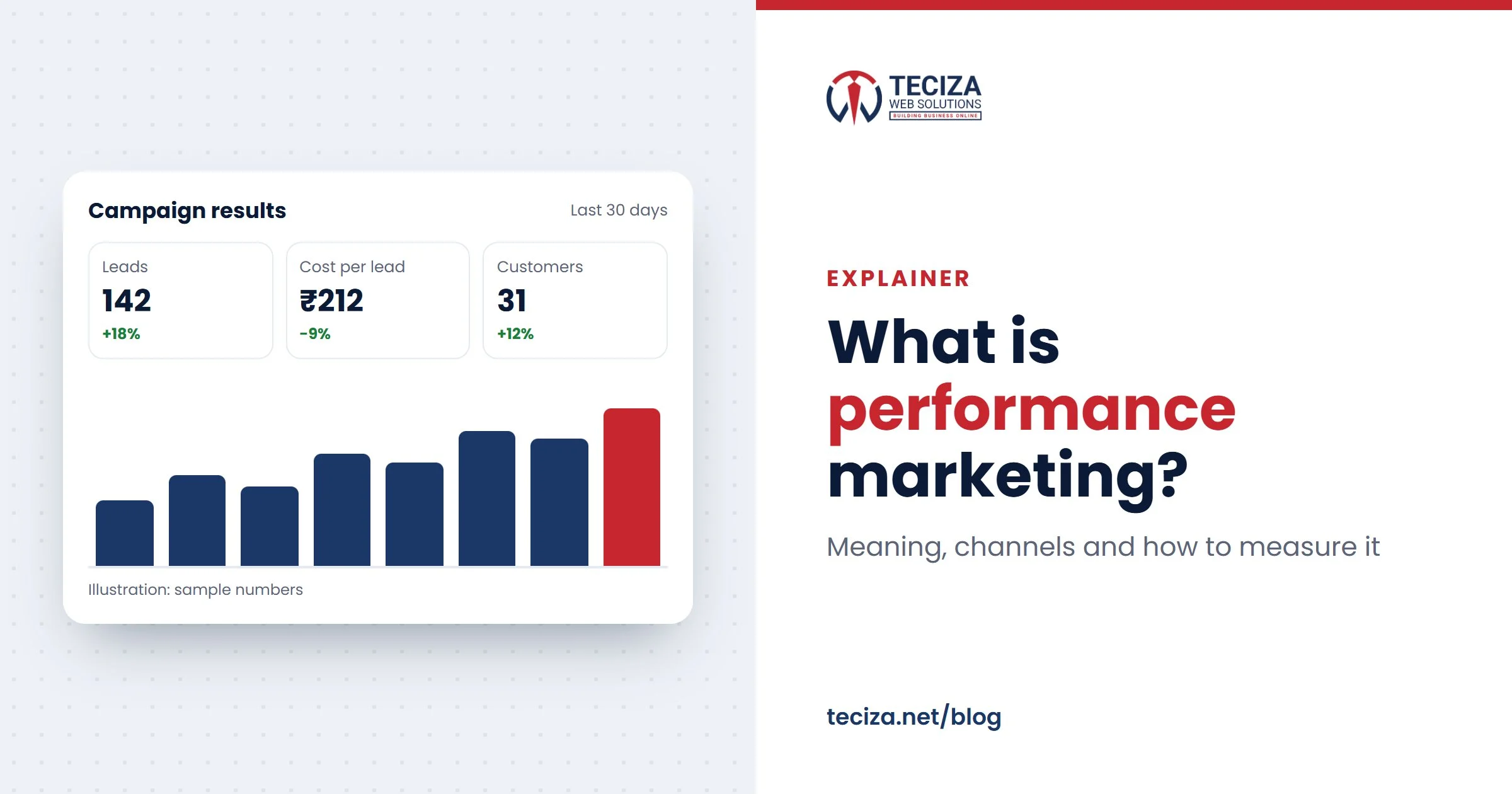
Short answer: what is performance marketing? It is marketing you pay for and judge by measurable actions: a lead, a sale, a phone call or an app install. You decide the action first, track it, and move your budget towards the ads that bring it at a cost you can afford. Google Ads, Meta Ads, shopping ads, affiliate deals and retargeting are the usual channels.
This guide is for business owners in India who hear the term from agencies: how it differs from brand and digital marketing, the channels and pricing models, the metrics with worked examples, tracking, and what AI changes.
What is performance marketing? The meaning in plain words
With ordinary advertising you pay to be seen and hope it leads to business. With performance marketing every rupee is tied to an action you can count: a clinic counts appointment requests, an online store counts orders and their value.
One point confuses many owners: “performance” describes how you judge the spend, not always how you are billed. On Google and Meta you mostly pay per click or per thousand impressions, and measure the results. Paying only for results is less common: affiliate commissions, some lead deals, and a few Google Display campaigns.
When we run campaigns, the client pays the ad budget directly to Google and Meta, and our fee is separate.
Performance marketing vs brand marketing vs digital marketing
Performance marketing vs brand marketing
Brand marketing makes people know and trust you before they need you. Performance marketing turns people who are ready into enquiries and sales. You need both: brand work creates the demand that performance ads capture.

Read this comparison as a table
| Performance marketing | Brand marketing | |
|---|---|---|
| Goal | Leads, sales, calls, installs | Recall, trust and preference |
| Reaches | People ready to act | Future buyers, not looking yet |
| Judged by | Cost per lead, cost per customer, ROAS | Reach, recall, searches for your name |
| Typical channels | Search, Shopping, lead and retargeting ads | Video, social content, sponsorships, outdoor |
| Speed | Quick, stops soon after the ads stop | Slow, lasts longer |
| Weak spot | Competes for demand that already exists | Hard to measure exactly |
Our advice: don’t cut all brand activity because it “doesn’t convert” in a report. Fewer searches for your name leave your ads less demand to capture.
Performance marketing vs digital marketing
| Digital marketing | Performance marketing | |
|---|---|---|
| Covers | Website, SEO, Business Profile, social media, email, content and ads | The paid part, judged by leads and sales |
| You pay for | Time (yours or an agency’s), plus ad spend where there are ads | Ad spend per click, impression or result, plus management |
| Judged by | A mix: rankings, traffic, followers, leads, sales | Cost per lead, cost per customer, ROAS |
| When you stop paying | SEO and content keep working for a while | The ads stop, and so do their leads |
Performance marketing channels
- Google Search ads: text ads for people searching for what you sell, usually the first channel for services and B2B (see how Google Ads works).
- Shopping and marketplace ads: Google product ads with image and price from a Merchant Center feed, and marketplace ads such as Amazon’s Sponsored Products, paid per click.
- Meta ads: Facebook and Instagram ads with lead forms or a WhatsApp chat button, shown to people chosen by location and interests.
- YouTube: video ads through Google Ads, to show a product in use and remind past visitors.
- Retargeting: ads for people who visited your site but didn’t enquire.
- Affiliates: partners such as deal sites and bloggers earn a commission per sale or lead.
- Ads in AI answers: Google shows ads in AI Overviews and AI Mode, and businesses in India can buy ChatGPT ads.
Start where your buyers already are. We compare the two biggest in Google Ads vs Meta Ads and run both as Google Ads and Meta Ads services.
How you pay: CPC, CPM, CPL, CPA and ROAS bidding
| Model | You pay for, or aim for | Where you see it |
|---|---|---|
| CPC (cost per click) | Each click | Google Search (Manual CPC, Maximise clicks), Amazon Sponsored Products, ChatGPT ads |
| CPM (cost per 1,000 impressions) | Ads shown | Most Meta ads; YouTube and Display |
| CPV (cost per view) | A video view or interaction | YouTube video ads |
| CPL (cost per lead) | Each lead | Lead deals and affiliate networks. On Google and Meta, a result you measure, not a billing unit |
| CPA (cost per action) | A cost per conversion you aim for | Google Target CPA, Meta’s cost per result goal |
| ROAS bidding | Sales value per rupee spent | Google Target ROAS and Maximise conversion value, Meta’s ROAS goal |
| Commission | A share of each sale | Affiliate programmes |
A target is not a price. Google says that with Target CPA some conversions cost more than your target and some less, and Search ads are still billed per click. On Google, paying per conversion is possible only in Display campaigns with more than 100 conversions in the last 30 days. On Meta, a bid cap limits each bid; the cost per result and ROAS goals are aims.
The metrics that matter, with worked examples

| Metric | How to work it out | What it tells you |
|---|---|---|
| Cost per lead (CPL) | Ad spend ÷ leads | What an enquiry costs. Easy to push down with poor leads. |
| Cost per qualified lead | Ad spend ÷ leads that fit your need, area and budget | What a real prospect costs |
| Cost per acquisition (CPA) | Ad spend ÷ new customers | What a customer costs |
| Return on ad spend (ROAS) | Sales value ÷ ad spend | Sales per rupee, before your margin |
| Conversion rate | Leads or sales ÷ clicks | How well page and offer work |
| Customer lifetime value | What a customer pays you over the whole relationship | What you can afford to win one |
The numbers in both examples below are made up to show the maths. They are not benchmarks.
Example 1: a CA firm in Ahmedabad
The firm spends ₹40,000 a month on Google Search ads and gets 1,000 clicks and 50 enquiries.
- Conversion rate: 50 ÷ 1,000 = 5%. CPL: ₹40,000 ÷ 50 = ₹800.
- 20 enquiries are businesses that need the service. Cost per qualified lead: ₹2,000.
- 5 become clients. CPA: ₹8,000.
- Each client pays ₹12,000 a year. First-year ROAS: ₹60,000 ÷ ₹40,000 = 1.5.
- Clients stay four years on average, so each is worth ₹48,000. Lifetime ROAS: ₹2,40,000 ÷ ₹40,000 = 6.
On first-year numbers the campaign looks weak. On lifetime value, ₹8,000 to win a ₹48,000 client is a good trade.
Example 2: an online saree store in Surat
The average order is ₹2,500 and the gross margin 40%, so each order leaves ₹1,000 before ads: the break-even CPA. Break-even ROAS is 1 ÷ 0.40 = 2.5. At a ROAS of 3, each ₹1 of ads brings ₹3 in sales and ₹1.20 of gross profit: ₹0.20 left before shipping, returns and payment fees. The same ROAS can be a profit for one business and a loss for another.
Tracking setup: what to install before you spend
- The Google tag on every page, directly or through Google Tag Manager. One tag can send data to Google Ads and Google Analytics.
- GA4 key events: mark the actions that matter (form sent, call tap, WhatsApp tap, purchase) as key events. Google Ads can create conversions from them.
- Google Ads conversions: only actions that should steer bidding as primary; secondary ones are for watching. Keep auto-tagging on: Google says it is needed to track conversions on all browsers.
- Meta Pixel plus the Conversions API: the Pixel records actions in the browser, the Conversions API sends them from your server or CRM. Check that events are deduplicated.
- UTM tags on links without auto-tagging, such as Meta ads and emails. Google says to always use utm_source, utm_medium and utm_campaign.
- A lead sheet or CRM recording each lead’s source and whether it bought. Send that back (enhanced conversions for leads on Google, the Conversions API on Meta) so the platforms learn from customers. More in lead to deal.
Test before launch. Send one test enquiry and check that it appears once, not twice, in Google Ads, GA4 and Meta Events Manager.
Why the numbers never add up: attribution and consent
Each platform reports the conversions it believes it caused, by its own rules. Google Ads counts conversions up to 30 days after a click by default and uses data-driven attribution for most conversion actions. Meta can also count people who saw or engaged with an ad without clicking, depending on the attribution setting. Google Analytics applies its own rules across channels.
A customer who clicked a Google ad, then saw an Instagram ad, then bought, can appear in both reports, so the totals add up to more sales than you made. Our advice: compare channels in GA4 with UTM tags, and treat your sales register or CRM as the final word.
Consent adds more gaps. Google’s consent mode passes each visitor’s cookie choice (ad_storage, analytics_storage, ad_user_data, ad_personalization) to Google tags. In advanced mode, tags send cookieless pings when consent is denied and Google models the missing conversions. It is not a banner: you still need one, especially if you advertise in the EEA, Switzerland or the UK. In India, the DPDP Act, 2023 and the DPDP Rules notified in November 2025 come into force in stages, most duties 18 months after notification. Ask your lawyer what applies to you.
How AI bidding changes the work, and why data quality matters more
Bids used to be set by hand. Now Google’s Smart Bidding (Target CPA, Target ROAS, Maximise conversions, Maximise conversion value) uses Google AI to optimise for conversions or conversion value in every auction, with signals such as device, location and time of day. Meta’s Advantage+ sales, leads and app campaigns let Meta’s AI handle the audience, placements and budget.
The AI optimises for whatever you tell it counts. If a visit to the contact page counts as a lead, it finds more people who visit: cost per lead falls while sales don’t move. Your inputs are now the work:
- Clean conversions: only real actions as primary conversions, no duplicates.
- Real values: Target ROAS needs conversion values, so give orders and qualified leads their real value.
- Feedback from sales: send back which leads became customers.
- Ads and pages: the AI picks who sees the ad; the ad and page decide whether they act. Our advice: a landing page for each offer, not the home page.
- Patience: Google suggests judging Smart Bidding over a period with at least 30 conversions (50 for Target ROAS).
AI search adds new places to advertise. Google shows ads in AI Overviews and AI Mode, labelled “Sponsored”; Search, Shopping and Performance Max campaigns are eligible automatically, and India is listed, in English. Indian businesses can buy ChatGPT ads in OpenAI’s self-serve Ads Manager, with cost-per-click bidding, and links clicked in ChatGPT carry utm_source=chatgpt.com, so those visits show in GA4. Judge every new channel by qualified leads and sales.
The performance loop, and the mistakes we see
Performance marketing is a loop, not a launch: track (Google tag, Pixel and UTM tags, tested), launch (one offer, one page, one goal), measure (qualified leads and sales, not clicks), improve (cut waste, move budget to what brings customers, change one thing at a time, feed sales back).

The mistakes we see most often in ad accounts:
- Judging by clicks or CPL alone. Cheap leads that never buy are the most expensive kind.
- Counting the wrong things: page views, button clicks without a sent form, the same lead twice.
- Sending every ad to the home page instead of a page for that offer.
- Slow follow-up. By the next day, a lead may have called someone else.
- Splitting a small budget across many channels, so none gets enough data.
If leads don’t turn into customers, check the follow-up before the ads. Our lead generation service builds campaigns, landing pages and follow-up as one system.
Common questions
Is performance marketing the same as digital marketing?
No. Digital marketing covers everything online, including SEO, social media and email. Performance marketing is the paid part, judged by leads and sales.
What does a performance marketer do?
Sets up tracking, plans campaigns and budgets, briefs the ads, watches cost per customer and moves money to what brings sales. With AI bidding, more of the job is clean data, good ads and landing pages.
What is a good ROAS?
It depends on your margin. Break-even ROAS is 1 divided by your gross margin: with a 40% margin, 2.5. Below that, you lose money on the first sale unless customers buy again.
Is SEO part of performance marketing?
Not usually. You can measure the leads SEO brings, but you don’t pay per click or per result for those visits.
How much budget do I need to start?
Meta says there is no minimum budget, and on Google Ads you set your own. Work back from the cost per lead you expect: enough conversions each month for the bidding to learn and for you to judge.
A useful first step costs nothing: write down what a customer is worth to you over time and what you could pay to win one, then send a test enquiry and check that your tracking records it. If you’d like a second opinion, we offer a free ads review.
Sources: Google Ads Help: Determine a bid strategy based on your goals; Google Analytics Help: Mark events as key events; Google for Developers: Consent mode overview; Meta: Meta Advantage+; Amazon Ads: Sponsored Products; OpenAI: Ads Manager availability. Checked November 2026.
Written by the Teciza Team: digital marketing, software and website specialists in Ahmedabad since 2015. Last updated 24 Nov 2026.
More guides
ChatGPT ads: what they are, who can use them and what they mean for you
ChatGPT now shows ads, and businesses in India can buy them directly. How they work, who sees them, what you can't advertise yet, and what we'd…
Social media agency in Ahmedabad: what to expect and how to choose
What a good social media agency should deliver each month, local content that works in Ahmedabad, what to measure, who owns your accounts and the red…
Best digital marketing company in Ahmedabad: how to choose
Agency, freelancer, consultant or in-house? Match the channels to your business, compare two or three partners on one scorecard, and get the contract and account ownership…
Want help with this?
- Tell us what you needMarketing, software or a website.
- We look at your businessYour site, your market, your goals.
- We call you backWith ideas and, if you want, a quote.
Tell us about your business
A few short questions. We reply by call or WhatsApp, 7 days a week.
Your details are only used to reply to you. Need a detailed quote? Fill our project brief.