ChatGPT ads: what they are, who can use them and what they mean for you
ChatGPT now shows ads, and businesses in India can buy them directly. How they work, who sees them, what you can't advertise yet, and what we'd do before spending on them.
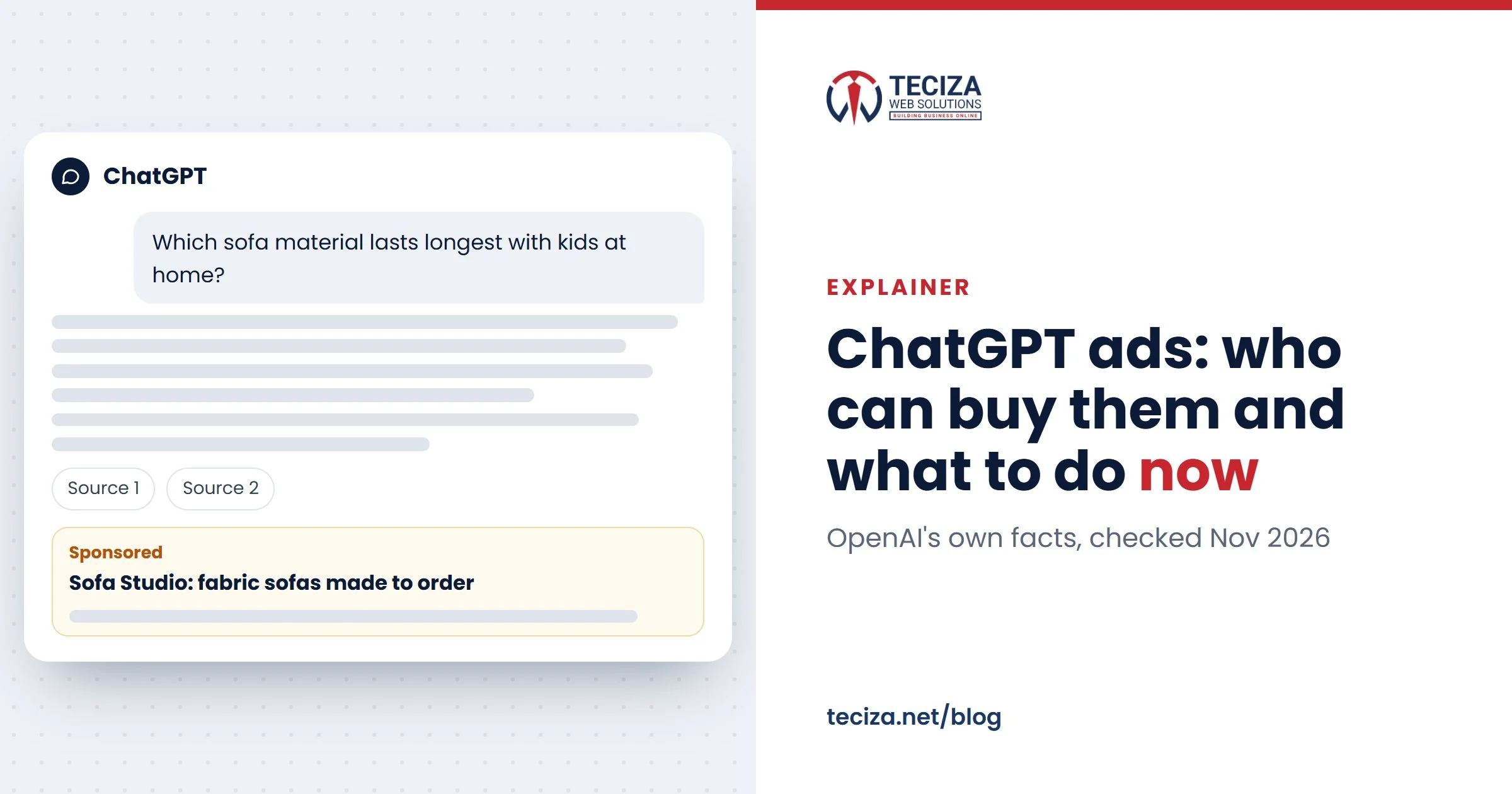
Short answer: ChatGPT ads are paid, clearly labelled ads that OpenAI shows below ChatGPT’s answers to adult users on the Free and Go plans. Plus, Pro, Business, Enterprise and Edu accounts don’t see them. Testing started in the US on 9 February 2026, ads now run in 89 countries including India, and since 31 August 2026 businesses based in India can buy them directly in OpenAI’s Ads Manager. OpenAI says the ads don’t change ChatGPT’s answers.
This guide is for business owners in India deciding whether ads on ChatGPT matter yet: how they work, who can buy them, what you can’t advertise, how they compare with Google and Meta ads, and how to appear in ChatGPT’s answers without paying. Platform facts come from OpenAI’s own pages, checked on 11 November 2026.
What ChatGPT ads look like and who sees them
A ChatGPT ad is one ad unit under a ChatGPT response, marked as sponsored and kept apart from the answer. Each ad has:
- the advertiser’s name and small logo
- a headline and a short description
- one image, or 4 to 6 square images in the multi-image format (open beta in Ads Manager since 26 October 2026)
- a link to the advertiser’s landing page
OpenAI is also testing, in the US, a visual ad shown while ChatGPT creates an image.
| ChatGPT account | Sees ads? |
|---|---|
| Free | Yes, unless the user picks the ad-free option, which has fewer messages and no image tools |
| Go | Yes |
| Plus, Pro, Business, Enterprise, Edu | No |
| Accounts OpenAI identifies as under 18 | No |
| Temporary Chats | No |
Ads stay away from sensitive chats such as personal health, mental health and politics. Users can hide or report an ad, see why it was shown and switch off personalisation.
ChatGPT ads in India: the timeline so far
| Date (2026) | What OpenAI announced |
|---|---|
| 16 January | Plans to test ads in the US on the Free and Go plans, with five ad principles |
| 9 February | Test starts in the US for logged-in adults |
| 5 May | A beta self-serve Ads Manager and cost-per-click (CPC) bidding |
| 11 August | Launch in the UK, Mexico, Brazil, Japan and South Korea |
| 31 August | Self-serve buying opens in India, Europe, the Middle East and North Africa; OpenAI reports a US$1 billion annualised revenue run rate from ads |
| 23 September | Southeast Asia and Taiwan, after earlier launches in Australia, New Zealand, Japan, South Korea and India |
| 21 October | 26 more countries, 89 in total; over 100,000 advertisers have run campaigns |
| 10 November | Businesses in ChatGPT (beta): a way to claim your business details, separate from ads |
OpenAI hasn’t published the date users in India started seeing ads, but it names India as a launch market. It says over 1.2 billion people use ChatGPT each week, but not how many are in India or on ad-supported plans.
Can Indian businesses advertise on ChatGPT?
Yes. OpenAI’s Ads Manager availability list shows India as available for self-service. The legal entity that advertises and is billed must be based in a listed country, so a business registered in India qualifies.
- Go to ads.openai.com and sign in with an OpenAI account. Your ChatGPT login works.
- Enter your website. Ads Manager can draft a first ad from it, or you can skip this step.
- Add your brand name (shown on your ads) and your registered legal name.
- Add a card under Billing. Campaigns don’t run without it.
- Set the objective, budget, dates and locations, and write your ads. They go live after OpenAI reviews them.
- Objective: Views (pay per 1,000 impressions), Clicks (pay per click) or Conversions (optimised for a conversion event but still billed per click or per 1,000 impressions, not per conversion).
- Budget: the minimum daily budget is ₹725 for accounts billed in rupees.
- Bids: you set a maximum bid and an auction decides which ad shows. For click campaigns, OpenAI’s guide suggests a starting maximum bid of US$3 to US$5 per click. That is a general suggestion, not an Indian rate.
- Locations: countries, plus states, cities and postal codes where supported. New self-serve accounts may at first advertise only in their home country.
Before you sign up: your country, currency and time zone can’t be changed after the ad account is created. A daily budget is an average over the week, so spend on a single day can reach twice the amount you set.
What you can’t advertise on ChatGPT yet
This is where many Indian businesses stop. OpenAI’s ad policies (updated 10 September 2026) limit ads mainly to consumer categories for now: lifestyle and household goods, local services, travel and experiences, and digital products or education. Several of India’s biggest ad categories are closed outside the US.
| Your business | ChatGPT ads in India today |
|---|---|
| Online shop: fashion, home goods, gifts | In scope, subject to review |
| Local services: interiors, repairs, cleaning, salons | In scope, subject to review |
| Hotels, tour operators, experiences | In scope, subject to review |
| Software, apps, online courses | In scope, subject to review |
| Clinics, hospitals, dentists | No: health services outside the US are generally prohibited |
| Loans, insurance, investments | No: financial services outside the US are generally prohibited |
| Lawyers and legal services | No: prohibited outside the US |
| Individual property or job listings | No: prohibited everywhere |
| Alcohol, betting, dating, political ads | No |
| Manufacturers, exporters, other B2B | Not named in the list: check before you plan around it |
“In scope” doesn’t mean approved. OpenAI reviews every ad, image and landing page, the page must match the ad, and it must not block OpenAI’s crawlers (OAI-AdsBot and OAI-SearchBot). If your business is in a closed category, put your effort into the free steps further down.
How ChatGPT picks which ad to show
There are no exact-match keywords. OpenAI says its system weighs:
- the topic and intent of the current conversation
- your ad’s headline, description and landing page
- context hints you add: topics or phrases where your offer fits. They guide matching but don’t guarantee delivery
- your targeting: locations, devices and custom audiences (an included audience needs at least 25,000 matched users)
- past chats and memory, for users who have personalisation switched on
When several ads qualify, relevance and bids decide which shows first.
What advertisers see, and what they never see
Advertisers get aggregated numbers: impressions, clicks, spend, click-through rate, average cost and conversions. OpenAI says they never receive users’ chats, memories, names, email addresses, precise location or IP addresses. Conversions can be measured with OpenAI’s pixel and Conversions API, and UTM tags on your ad links show those visits in Google Analytics.
The answer is not for sale
OpenAI says ads run on separate systems from the chat model, and advertisers can’t shape, rank or change ChatGPT’s answers. So a business has two separate goals in ChatGPT: the ad slot, which you buy, and a mention inside the answer, which you earn.
ChatGPT ads vs Google Search ads vs Meta ads

Read this comparison as a table
| ChatGPT ads | Google Search ads | Meta ads | |
|---|---|---|---|
| Where they show | Below a ChatGPT answer | Google search results | Facebook and Instagram |
| Shown when | The conversation fits your offer | A search matches your keywords | Someone fits the audience you chose |
| The person is | Exploring and comparing options | Looking for something now | Scrolling, not searching |
| Targeting | Conversation context, location, device, custom audiences | Keywords, location, device, audiences | Location, age, interests, custom audiences |
| Measure with | Pixel, Conversions API, UTM tags | Google tag, Google Analytics | Meta Pixel, Conversions API |
| In India | Self-serve since 31 August 2026 | Long-standing, with plenty of benchmarks | Long-standing, with plenty of benchmarks |
Our view: Google Search ads reach people who already know what they need. Meta ads reach people who weren’t looking. ChatGPT ads sit in between, while the person is still comparing and asking follow-up questions. That is a useful moment, but the tools are in beta and there are no Indian benchmarks yet. For most businesses we’d treat ChatGPT ads as a test next to Google Ads and Meta ads, not a replacement. Our Google Ads vs Meta Ads comparison covers how to split a budget between those two.
Google is moving the same way: Search ads can now appear inside AI Overviews and AI Mode in India (in English), and existing Search, Shopping and Performance Max campaigns are eligible automatically.
Should you try ChatGPT ads now? Our checklist

Our advice: run a small test only when all five of these are true.
- Your category is allowed in India. Check OpenAI’s ad policies first.
- People ask ChatGPT about what you sell. If nobody asks it about your kind of offer, there is little for an ad to match.
- Your tracking works. Forms, calls, WhatsApp clicks and purchases are recorded as conversions, and every ad link carries UTM tags such as
?utm_source=chatgpt&utm_medium=paid. - You have a landing page for the offer. OpenAI advises a specific product, collection or content page rather than your home page. It should answer what the person was just asking: what it is, who it suits, where you serve and how to get in touch.
- Your Google and Meta ads keep running. Fund the test separately, and judge it on leads and cost per lead, not clicks.
Write several versions of each ad: OpenAI says clear, specific, benefit-led text is more likely to be relevant than a catchy line. If any point above is a “no”, fix it first. Tracking and landing pages improve your Google and Meta results too.
How to get mentioned in ChatGPT’s answers without paying
The ad sits under the answer, but most of the trust sits in the answer, and nobody can buy a place there. When ChatGPT searches the web it sometimes works with partner search providers, and OpenAI’s help centre names Microsoft among them.

- Let OpenAI’s crawler in. OpenAI says your robots.txt must allow OAI-SearchBot, and your host or CDN must allow its published IP addresses, for your site to be eligible for ChatGPT search answers. Blocking GPTBot, which collects training data, is a separate choice.
- Be on Bing as well as Google. Verify your site in Bing Webmaster Tools and submit your sitemap.
- State clear facts on your site. One page per service, in your customers’ words, with who it is for, the areas you serve and how to contact you. Keep your name, address and phone number the same everywhere.
- Build proof on other sites. A complete Google Business Profile, real reviews and accurate listings on your industry’s directories give assistants more to go on than your own pages.
- Claim your business in ChatGPT if you can. Business Hub (beta since 10 November 2026) lets owners claim and update a business. For now, local stores and restaurants can claim only existing US listings, Business Agents are US-only, and OpenAI says claiming doesn’t guarantee more visibility.
- Track it. ChatGPT adds
utm_source=chatgpt.comto the links it sends, so Google Analytics can show visits and leads from ChatGPT answers.
Check, don’t assume: we have seen hosting-level bot protection answer AI crawlers with error codes. Ask your developer to look for OAI-SearchBot in the server logs. OpenAI says robots.txt changes take about 24 hours to reach its search systems.
Most of this is SEO done properly, plus a few AI-specific checks. We explain why it matters more each year in why digital marketing matters more in the AI era. If you also want customers to get quick answers on your own website or WhatsApp, an assistant built on your own information is a separate project; see our AI and automation services.
Common questions
Are ChatGPT ads available in India?
Yes. OpenAI names India as a launch market, and since 31 August 2026 businesses based in India can buy ChatGPT ads themselves in Ads Manager.
How much do ChatGPT ads cost?
You set a budget and a maximum bid, and an auction sets the price. The minimum daily budget is ₹725 for rupee accounts, and you pay per 1,000 impressions or per click, not per conversion.
Do ChatGPT ads change ChatGPT’s answers?
OpenAI says no. Ads run on separate systems, are labelled and shown apart from the answer.
Can I pay to be recommended in ChatGPT’s answers?
No. You can buy the ad slot under the answer, not a place in it. Being mentioned depends on what ChatGPT finds about your business on the web.
What are OpenAI ads, and where do I sign up?
“OpenAI ads” usually means the ads OpenAI sells inside ChatGPT. Businesses sign up at ads.openai.com.
Who sees ads on ChatGPT?
Adults on the Free and Go plans. Plus, Pro, Business, Enterprise and Edu users don’t, and neither do Temporary Chats or accounts OpenAI identifies as under 18.
ChatGPT ads are open to Indian businesses, but they are new, the category rules are strict and the tools are in beta. Start with what pays off everywhere: crawler access, clear facts, reviews and working tracking. Then, if your category is allowed, test with a budget you can afford to learn from. If you’d like a second opinion on your setup first, we’re happy to look at it with you.
Sources: OpenAI: Our approach to advertising and expanding access to ChatGPT, Testing ads in ChatGPT; OpenAI Help Center: Ads in ChatGPT, Ads in ChatGPT: the basics; Google Ads Help: About ads in AI Overviews and AI Mode; Meta Business Help Centre: About detailed targeting. Checked November 2026.
Written by the Teciza Team: digital marketing, software and website specialists in Ahmedabad since 2015. Last updated 22 Nov 2026.
More guides
Google AI Mode: what it is and what it means for your business
What Google AI Mode is, how it differs from AI Overviews, how it works in India, where websites, local businesses, products and ads appear, and what…
Best digital marketing company in Ahmedabad: how to choose
Agency, freelancer, consultant or in-house? Match the channels to your business, compare two or three partners on one scorecard, and get the contract and account ownership…
Website design companies in Ahmedabad: how to brief and compare them
The one-page brief to send, how to check portfolios on your phone, a line-by-line quote comparison and the red flags to spot before you hire a…
Want help with this?
- Tell us what you needMarketing, software or a website.
- We look at your businessYour site, your market, your goals.
- We call you backWith ideas and, if you want, a quote.
Tell us about your business
A few short questions. We reply by call or WhatsApp, 7 days a week.
Your details are only used to reply to you. Need a detailed quote? Fill our project brief.