Best software company in Ahmedabad: how to choose the right one
Choosing a software company for custom billing, CRM, ERP or a dealer portal: what to decide first, what a proposal must state, who owns the code, and the red flags.
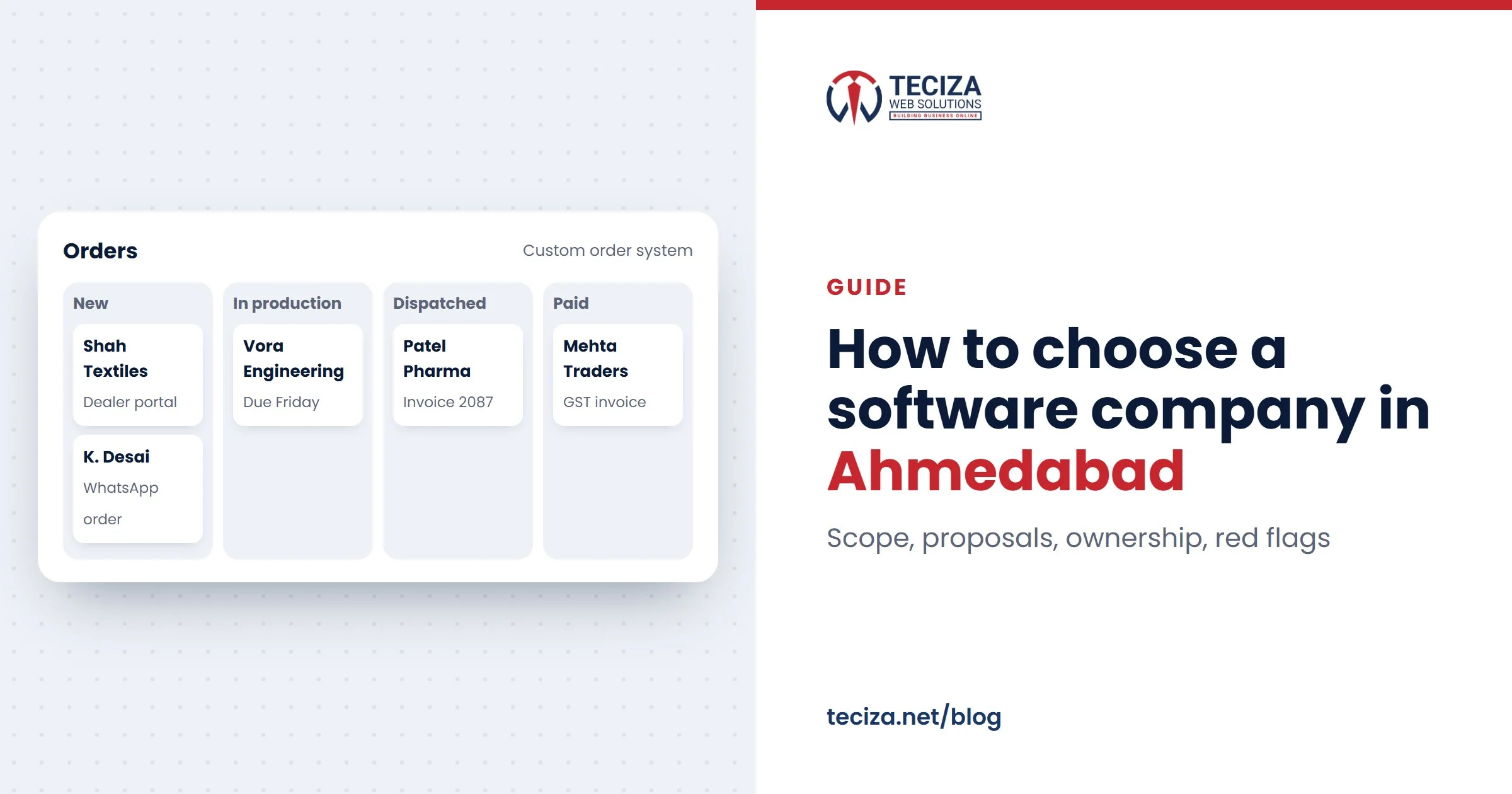
Short answer: the best software company in Ahmedabad for your business is the one that fits your project, not the one at the top of a list. Look for a company that studies your process before it quotes, puts the scope, price model, milestones, testing, training, data migration and support in writing, agrees who owns the code and the data, and can show you a similar system already in use. And before you call anyone, decide whether you need custom software at all.
This guide is for owners of trading firms, manufacturing units, distributors, clinics and service firms who want GST billing and inventory, a CRM, an ERP, a dealer portal or another web app built, or AI added to software they already use. It comes from our team in Ahmedabad, which has worked on 2,000+ projects since 2015 for businesses across India and in 8+ countries.
Decide first: ready-made, custom or a mix
If your business runs on Tally or another accounting package plus a stack of Excel sheets, keep what works. GST billing, accounts and payroll work much the same in every business, and a well-maintained product is updated when the rules change. Custom software earns its cost where your way of working is different: how you take dealer orders, price by customer, track lots and batches, or approve dispatch.
Often the answer is a mix: ready-made accounting, with a custom module that passes confirmed orders to it. Our comparison of custom vs ready-made software compares cost, fit and lock-in, and our guide to GST billing and inventory software covers billing. Need a website rather than software? Read our guide to choosing a website design company in Ahmedabad.
Custom software in Ahmedabad: what businesses usually ask for
Here are five hypothetical but typical requests. The third column is what a company must understand before it can quote.
| Business | Software it needs | What the company must understand first |
|---|---|---|
| A textile trader with a godown off SP Ring Road | Billing and stock by quality, colour and lot, in metres and pieces | Credit terms per retailer, brokers’ commission, goods returned |
| A pharma distributor supplying chemists | Order taking, batch and expiry tracking, schemes | Near-expiry returns, scheme rules that change monthly, delivery routes |
| An engineering unit in Vatva GIDC with dealers across Gujarat | A dealer order portal with price lists, dispatch status and outstanding | Prices and credit limits per dealer, part dispatches, the link to accounts |
| A clinic with two branches | Appointments, patient records and billing | Who may see which records, doctors’ schedules, reminders |
| A service firm with annual contracts | A CRM with service visits and renewals | How jobs are assigned and closed, when renewals fall due |
When follow-ups are the problem, the answer is usually a CRM. When sales, purchase, stock and production must share one set of numbers, it is an ERP. Dealer portals and booking systems are usually web apps that open in any browser, on a computer or a phone.
One check applies to every trader and manufacturer: since 1 August 2023, GST e-invoicing has applied to businesses with aggregate turnover above ₹5 crore. B2B invoices go to the government’s Invoice Registration Portal, which returns a reference number (IRN) and a QR code; software connects to it through APIs, directly or through a GST Suvidha Provider. If you are near that line, ask to see e-invoicing the company has already built, and confirm the rules with your CA.
The best software company in Ahmedabad for you asks before it quotes
A company that sends a fixed price after a ten-minute call is guessing, and you pay for the guess later, as change requests or features nobody uses. A proper discovery step covers:
- The work as it happens today, walked through with the people who do it: order, challan, invoice, return.
- Users and roles: who uses the system, and what each person may see and change.
- Documents and reports: your invoice formats, and the numbers the owner wants every morning.
- Connections: Tally, a payment gateway, WhatsApp, email, e-invoicing.
- The data to move: customer and item lists, opening stock, outstanding balances.
- The first version: what it must do, and what can wait.
Take the pharma distributor. It asks for “an order system”, but discovery shows the money is lost in near-expiry returns and in scheme discounts that change every month. A company that skipped discovery would build a neat order screen and miss both.
Discovery may be a few meetings or a short paid phase for a larger system. Either way, get the result in writing: scope, rough screens, connections, data to move and what is not included. That document makes proposals comparable.

From the first call to go-live, a well-run project follows five steps:
- Discovery: your process mapped with the people who do the work.
- Written scope and quote: screens, roles, exclusions and the price model, before work starts.
- Screens approved: you see them before the build begins.
- Build in stages: a working demo at each milestone, with payments against what works.
- Test, train, go live: your staff test with real cases, data is moved and checked, the team is trained.
Ownership of the code and the data is agreed before work starts, not at handover.
Comparing proposals: what each one must state
Put two or three proposals side by side. A missing line is a question to ask, not something to assume.

| Point | A clear proposal says |
|---|---|
| Scope and exclusions | Screens, user roles, reports and connections, and what is not included |
| Price and milestones | Fixed price or time and material, with payments tied to parts that work |
| Demos and testing | A demo at every milestone; your staff test with real cases; bugs fixed before go-live |
| Training | Who is trained, how and for how long, in the language your staff prefer: Gujarati, Hindi or English |
| Data migration | Which data moves from Excel or Tally, who cleans it, who checks opening stock and balances |
| Hosting and backups | Whose account the server is on, how often backups run, whether a restore has been tested |
| Support and AMC | What the annual maintenance contract (AMC) covers: fixes, updates, backups, response times; how new features are charged |
| Code and data ownership | Ownership or licence, source code access and data export |
Fixed price or time and material?
A fixed price is an agreed amount for an agreed scope. It suits a clear, stable first version. Anything outside the scope becomes a change request with its own quote, so insist on a detailed scope with exclusions. The risk is a padded price or arguments over scope. Pay by milestones you can see working.
Time and material means paying for the hours actually worked, at agreed rates. It suits changing or ongoing work, such as improvements after launch, and changes are simply added to the hours. The risk is cost that keeps running, so ask for an estimate per stage, regular hours reports, and payments monthly or per stage within a cap.

Our advice: for a first system, a fixed price for the first version works well, followed by time and material or an AMC for what comes next.
Who owns the code and the data? Get it in writing
There is no single answer: who owns custom code depends on the project and the contract. Some companies assign the code to the client; others license it for your use and keep reusable parts, such as their own framework. Both can be fair; finding out after go-live is not. Agree in writing before work starts:
- The code: assigned or licensed, on what terms, and whether another developer may work on it later.
- Source code: a copy at each milestone, or access to the repository.
- Your data: an export in a usable format, such as Excel or CSV, at any time and when the contract ends.
- Accounts: hosting, domain and payment gateway accounts in your business’s name where possible.
- Paid parts and handover: outside components or AI services the system needs, who pays for them, and documentation another developer can work from.
Under India’s Copyright Act, 1957, the author of a work is generally its first owner, an employer first owns what its employees create in the course of employment unless they agree otherwise, and an assignment of copyright is valid only in writing, signed by the person assigning it. An outside company’s staff are not your employees, so paying for the work does not by itself make you the owner. This is general information, not legal advice: ask your lawyer.
Don’t sign until ownership is clear. Code ownership depends on the project, so agree it in writing before work starts, with source code access, data export and the accounts in your name. It is easy to settle at the start and hard later.
Check references and see a similar system at work
- Speak to two or three clients with a similar system, the owner and someone who uses it daily. Did it go live as planned? How were changes handled? How fast are problems fixed now?
- Ask for a live demo of a similar system, not slides. Client systems are often private, but a demo copy with sample data works.
- Meet the people who will build it, not only the person who sells it. With a company in Ahmedabad, you can visit the office before you sign.
- Ask which of their systems has run longest and whether they still support it, years later.
Many owners now ask ChatGPT or Google’s AI Mode for the top software companies in Ahmedabad. Treat the answer as a place to start, not a verdict. Google’s own AI Mode help page says AI responses may include mistakes and advises checking important information in more than one place. A list shows who is visible online, not who fits your process; our article on digital marketing in the AI era explains how businesses get into these answers.
Red flags when choosing a software company
- A fixed price after one short call, with no questions about how you work.
- A one-page scope that says “complete ERP” or “as discussed”.
- A large advance, or payments not tied to working parts.
- Vague answers on code ownership, source code or data export.
- Hosting and backups only in the company’s name, with no way for you to get a copy.
- No testing time with your staff and no training in the plan.
- An ERP “ready in two weeks”, or AI that “runs your business by itself”.
- No similar system to show and no client you can call.
AI in business software: useful, with a person in charge
AI is worth asking about where it saves real time and a person stays in charge. Three uses work well:
- Ask your data: the owner of the Vatva unit types “which dealers in Saurashtra haven’t ordered this month?” and gets the answer from the live system. The AI should see only what that user may see.
- Summaries: a short morning note on yesterday’s orders, dispatches and overdue payments.
- Drafts a person checks: a payment reminder or a reply to a dealer, written by AI and sent only after someone reads it.
AI can often be added to software you already have, if the new feature can read its data safely. Ask which AI service the feature uses and whether your data trains its models: OpenAI, for example, says data sent to its API is not used to train its models unless you opt in. Ask what it costs to run: OpenAI prices its API per million tokens (small pieces of text), so the bill grows with use. And ask who checks the output before a customer sees it.
Common questions
Which is the best software company in Ahmedabad?
The one that fits your project: it asks about your process before quoting, puts scope, milestones, testing, training and support in writing, agrees code and data ownership, and can show a similar system working.
How do I find the top software companies in Ahmedabad?
Start with search, AI assistants and referrals from businesses like yours. Shortlist two or three, hold a discovery meeting with each and compare their written proposals.
How much does custom software cost?
It depends on the screens, user roles, connections and data to move. Ask for an itemised quote with a timeline in stages, and consider a smaller first version covering the part that helps most.
What should a software AMC cover?
Bug fixes, security and server updates, backups and agreed response times. New features are usually quoted separately, so get the list in writing.
Can custom software work with Tally?
Often, through regular exports and imports or an integration, depending on how your Tally is set up. Ask the company to show a link it has built before.
Before you call anyone, write one page: how an order moves through your business today, the three places it breaks, and what you want to see each morning. Give it to two or three companies and compare what comes back. If you want us on that list, you can see what we build as a software development company in Ahmedabad.
Sources: Copyright Office, Government of India: The Copyright Act, 1957, Chapter IV; GST Council: Notification 10/2023-Central Tax; GSTN: e-Invoice System; Google Search Help: Get AI-powered responses with AI Mode in Google Search; OpenAI: Data controls in the OpenAI platform, API pricing. Checked November 2026.
Written by the Teciza Team: digital marketing, software and website specialists in Ahmedabad since 2015. Last updated 21 Nov 2026.
More guides
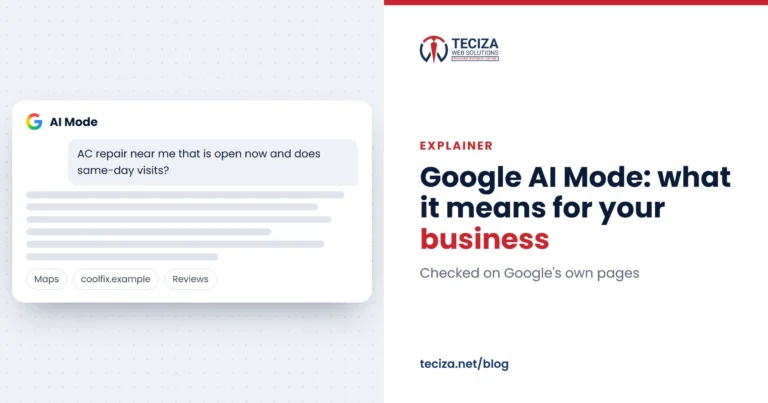
Google AI Mode: what it is and what it means for your business
What Google AI Mode is, how it differs from AI Overviews, how it works in India, where websites, local businesses, products and ads appear, and what…
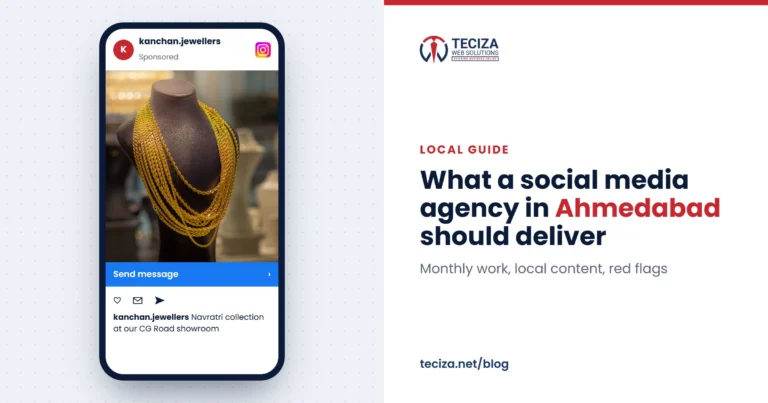
Social media agency in Ahmedabad: what to expect and how to choose
What a good social media agency should deliver each month, local content that works in Ahmedabad, what to measure, who owns your accounts and the red…

Best digital marketing company in Ahmedabad: how to choose
Agency, freelancer, consultant or in-house? Match the channels to your business, compare two or three partners on one scorecard, and get the contract and account ownership…
Want help with this?
- Tell us what you needMarketing, software or a website.
- We look at your businessYour site, your market, your goals.
- We call you backWith ideas and, if you want, a quote.
Tell us about your business
A few short questions. We reply by call or WhatsApp, 7 days a week.
Your details are only used to reply to you. Need a detailed quote? Fill our project brief.